Wednesday, May 21, 2014

The Avengers Initiative: Marvel's Movie Franchise

By Tildy Banker-Johnson
Superhero movies are not a new phenomenon
at all. They are certainly more recent then say, Dracula and ever since
Christopher Reed played the Man of Steel in Superman in 1978, there has been a widespread
market for superhero movies.
In the week before the new X-Men movie
comes out, I want to explore why these movies are so popular. They seem to appeal
to a wide range of audiences—not just those who love the comic books, nor those
who just enjoy a good action film. They also appeal to those of us who have never
read a comic book in their lives, and those of us who prefer not to waste time
or money on mindless action sequences, where CGI rules in things being blown
up, burnt down, and guns being fired and gore everywhere. They appeal to people
who enjoy action in addition to character
development and solid plot points. That being said, there’s nothing wrong with
a good fight or chase scene or two; I just prefer that it not be the entire
substance of the movie.
For those of you living under a rock, you
may not know that Marvel Entertainment is in the midst of building a franchise
of Hulk-sized proportions, with multiple movies, and even a television show
about all the superheroes in their universe, the link between them being the
secret government agency, S.H.I.E.L.D (Strategic Homeland Intervention,
Enforcement, and Logistics Division—not that any of the actors
except for maybe Clark Gregg, who repeats the name several times in Iron Man, could tell you that).
Technically, Marvel Entertainment doesn’t own the rights to the X-Men
franchise, although they do exist in the same universe, including the Fantastic
Four. The first of these was Iron Man,
starring Robert Downey, Jr. and directed by Jon Favreau, in 2008, and the most
recent film being Captain America: The
Winter Soldier, also known as Captain
America 2, starring Chris Evans and directed by Anthony and Joe Russo,
having just been released April 4th. Between these two movies stand seven
others, for a total of nine. The movies next to be released are Guardians of the Galaxy, Ant-Man, and The Avengers: Age of Ultron (aka The Avengers 2).
The
Avengers, which
premiered in May 2012, and was directed by Joss Whedon is the first film in the
franchise that fully incorporates a multitude of Marvel’s superheroes. They
are:
·
Captain
America, a.k.a. Steve Rogers
·
Iron
Man, a.k.a. Tony Stark
·
The
Black Widow, a.k.a. Natasha Romanoff
·
Hawkeye,
a.k.a. Cliff Barton
·
The
Hulk, a.k.a. Dr. Bruce Banner
·
Thor
Odinson, the Norse god of Thunder
The plot feels almost inconsequential to
just getting all these different personalities together in one place, let alone
working together, in order to fulfill “The Avengers Initiative,” created by S.H.I.E.L.D.
director Nick Fury. Aliens destroying New York? That’s nothing new. Although we
do see in the movies that come after The
Avengers, such as Iron Man 3,
that the world is reeling from the fact that “we are not alone.” You’d think
the Hulk’s fight with the evil, Hulk-like monster in The Incredible Hulk, which also takes place in New York City and is
the second in the franchise’s reboot, would have tipped somebody off to the
fact that weird things exist out there. Sure, Bruce Banner is technically a
human exposed to gamma radiation, but considering that’s supposed to be a
military secret, how are the citizens of the city, and the world, surprised to
learn about aliens?
What makes the Avengers appealing isn’t
really the main plot of invasive aliens lead by Thor’s adopted brother, Loki,
who, since he can’t be king of Asgard, wants to be king of Earth. What works
for audiences who enjoy more than just action is the character development that
occurs, not only between those who make up the Avengers, but also Nick Fury,
his staff (primarily Agent Coulson and Agent Hill), and Loki.
The dialogue of the film is what really
makes the character development accessible to the audience. There are many pithy one-liners that
come from all of the characters, not just the always-quotable Tony Stark. The
humor in these lines establishes relationships between the characters, both
those in the film, and those who appear off-screen. This expands on the overarching
connection Marvel had been building up to, through extra scenes in the first
five movies released before The Avengers.
In the films that come after The Avengers,
there are references back to it, such as when Jane Foster slaps Loki, and quips
“That was for New York,” when she meets him in Asgard in Thor: The Dark World (otherwise known as Thor 2).
The way in which the superheroes speak to
each other is not, at the start, a tone of camaraderie. There are clearly
tensions that exist, such as that between Captain America and Iron Man. This is
resolved later in the film through a crisis, in which the two have to work
together to save the ship that S.H.I.E.L.D.
is anchored on, and the teamwork they develop in this scene is demonstrated
later in the film, during the final showdown in New York. Other tensions at the
start of the film include Iron Man’s fight in the woods
with Thor, who has come to take his brother back to Asgard, or at least stop
him in invading from Earth, their sibling rivalry obvious, even to those who
didn’t see Thor. The fight occurs
when Thor takes Loki from the plane, and Iron Man and Captain America go after
him, and only ends when the Captain steps in, and insists they all return to S.H.I.E.L.D.
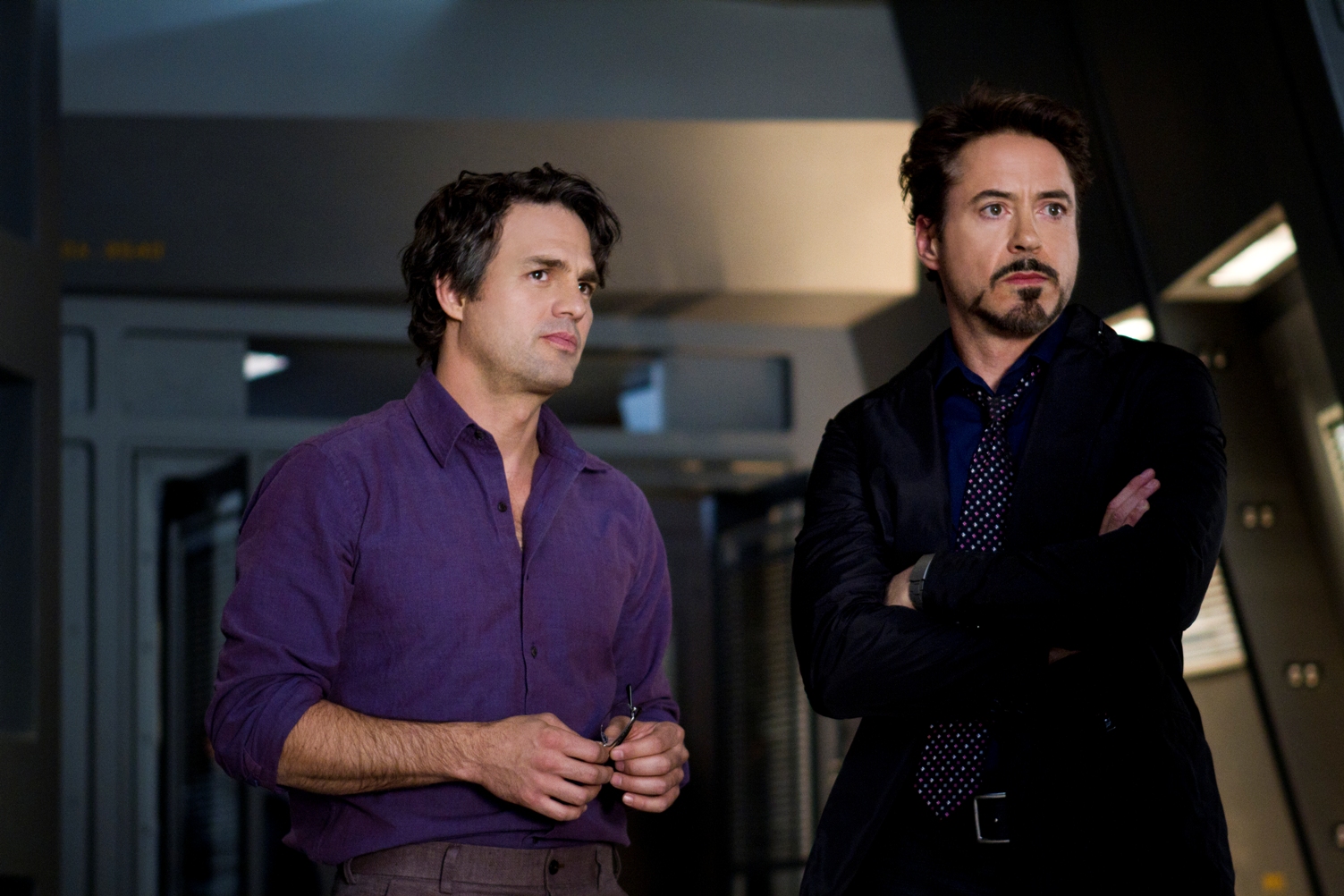
Everyone on the ship is nervous about
Bruce Banner, although both Fury and Romanoff attempt to reassure him that the
glass cage Loki is being held in was not intended for Banner, although in
reality revealed by Loki, it is. Only Tony Stark, who connects with him on a
scientific level, is upfront and honest about Banner’s “condition,” quipping
“and I’m a huge fan of the way you lose
At the start of the film, in a battle
sequence, which will immediately satisfy actions fans, two characters, Hawkeye
and Dr. Erik Selvig, vital to S.H.I.E.L.D., are, for a lack of a better word,
possessed, by Loki using the tesseract’s power
(near the end of the film, they are both “cognitively recalibrated,” and no
longer in Loki’s possession). Both of these characters are introduced to us in
one of the more lackluster films in the franchise, Thor. And yet, the audience need not know that—I had only seen Iron Man prior to seeing The Avengers in theaters, so I had no
prior knowledge of these characters were. And yet the way in which they are
introduced in this film reveals all the audience needs to know: Hawkeye is an
almost supernaturally gifted archer and agent for S.H.I.E.L.D., and Dr. Selvig
is an astrophysicist, or some other type of scientist working with the magical
cube. Whedon introduces these two to us through visual aides rather than
dialogue, as he does with almost all other characters in the film. Selvig is
typing calculations into a laptop, while examining the tesseract, and Hawkeye
has a bow strapped to his back. Usually dialogue is only helpful in
identification, when a character calls another by name, as when Selvig answers
Nick Fury’s question of where Agent Barton is with: “What, the Hawk? He’s up in
his nest,” and points upward. This sort of visual cue, in which the actors move
to convey information, works in conjunction with the dialogue to captivate the
audience. The use of visual aides however, is not prominent in all of the
franchise’s movies.
Prior to The Avengers, only Captain
America and Iron Man were
particularly well received by critics, with Iron
Man 2 receiving half-hearted praise, and Thor and The Incredible Hulk
doing poorly. In Thor, there seem to
be a lack of plot or motivation, and many of the characters seemed
two-dimensional. Thor mindlessly wants battle and glory, and Loki, though
clever, is obviously the villain. The special effects are what propel the film,
with the CGI-crafted city of Asgard, Bifrost (the rainbow bridge portal between
worlds) and the travel of the gods through the nine realms.
In The
Incredible Hulk, what did not work were the many, many action scenes. This
may have been a weak point in the movie, but was exacerbated by the fact that
when there was not action scene, there was barely any dialogue. The huge
information dump during the opening credits was particularly frustrating.
People are still getting settled, and everything is happening too quickly to
process. Here, Marvel assumed everyone knew the story of the Hulk, which may be
true in a basic sense, but a chance to digest the revealed information would
have been particularly helpful. CGI effects here too reign supreme in multiple
explosions, while army men shoot futilely at the Hulk. (The bullets clearly
bounce right off of him, so why are you
still shooting? I shake my head.)
After The
Avengers, the following Marvel movies have done much better. Granted two of
these were sequels (Captain America 2 and
Iron Man 3), but Thor 2 was much more character based, in which Jane Foster leads,
with similar pithy dialogue, and emphasis on character relationships, not only
in romance, but secondary relationships, such as with Thor and Loki’s mother,
Frigga, and her bond not only to her sons, but to Jane as well. Secondary
characters, such as Darcy, Jane’s research intern, and Dr. Selvig, are given more dialogue and provide more comic
relief in relation to the plot (releasing the dark energy that possess Jane).
This emphasis, taking its lead from The
Avengers, created a more well-rounded and enjoyable film.
Aside from the dialogue that develops
characters and relationships, one of the prominent themes running throughout
the superhero movies is that they strive to make protagonist human, in some
way, shape or form—usually having to do with love. In The Avengers, we don’t see this humanizing quality as much,
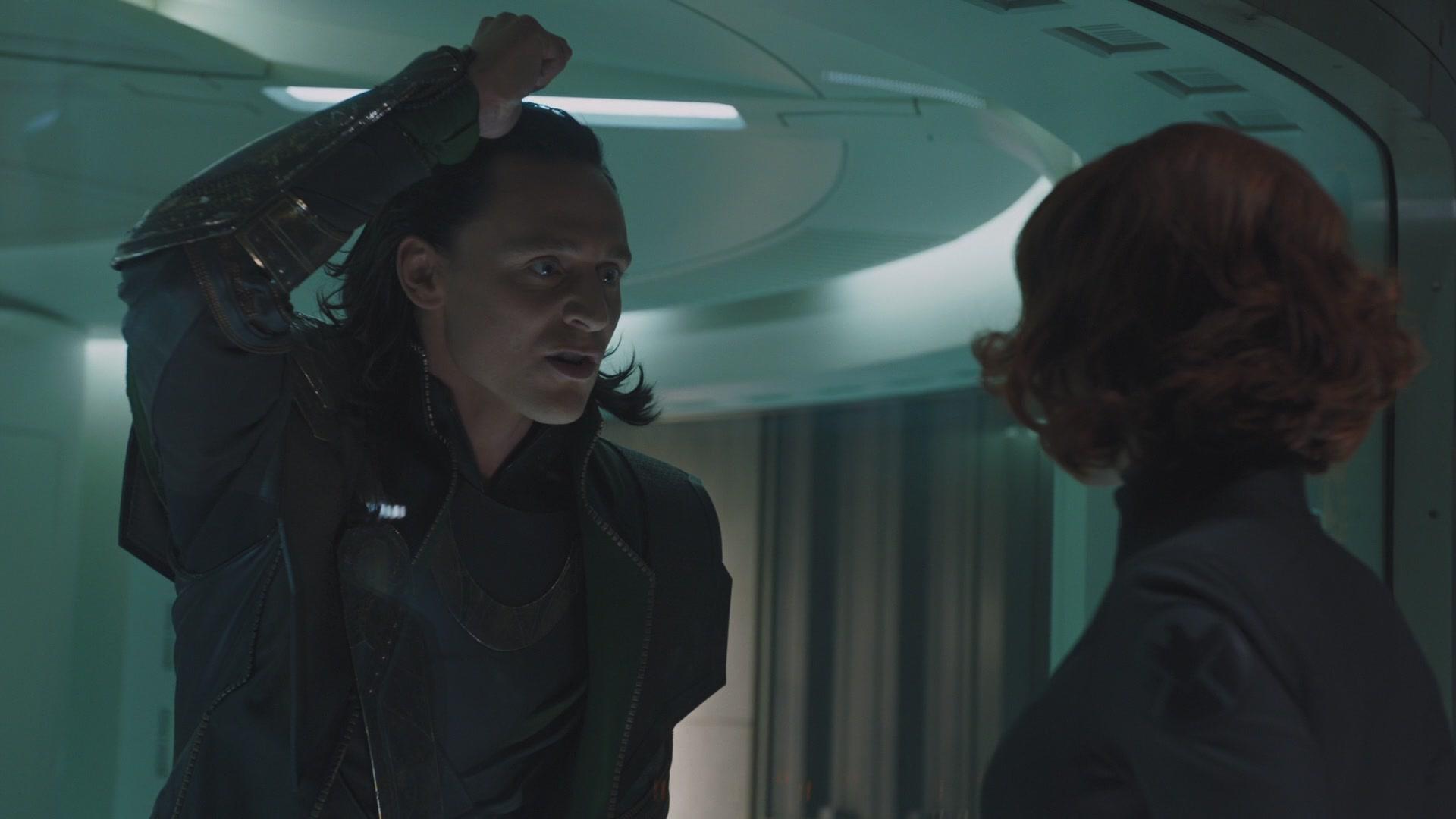
although the scene in which Loki threatens Natasha, we see, or think we see a
soft spot in her. He threatens to make Hawkeye, still possessed at this point
in the film, kill her, and then wake him up long enough for him to see what
he’s done, and then Loki will kill him too. He spits at Natasha “you mewling
quim,” screaming through the walls of his glass cage, and she turns her back on
him, seemingly sobbing. “You're a monster,” she says, and then Loki chuckles
sinisterly, and says “Oh no, you brought the monster.” Natasha whips around,
calm and clear, and we see that she has played Loki right into her hands, in
getting him to reveal his plot to in allowing himself to be captured—to trigger
Sometimes the humanizing quality is more
obvious than in others, such as in Thor.
The Norse god is actively stripped of his power and sent to Earth, where he
falls in love with scientist Jane Foster. Ultimately he becomes a god again
when his act of selfless self-sacrifice makes him worthy of wielding his hammer
again. But as Loki so keenly points out, Thor is different (I believe “soft” is
his choice phrase) than when he was banished from Asgard, and it’s “because of
her.”
In other cases, it’s somewhat more subtle.
Take Tony Stark. Over the three Iron Man movies he progresses from a selfish
“genius, billionaire, playboy, philanthropist” who “doesn’t play well with
others” to a man with a heart, as Pepper Potts so aptly points out in the first
film. By Iron Man 3, we see Tony
seemingly risking his own life to save those ejected from the fiery explosion
of Air Force One, because he can only carry four, but there are thirteen to
save. Through a barrel-of-monkeys technique, better explained when seen, Tony is able to
save them all. Only we find out after they have all been safely dropped in the
water, that Tony was never in that particular suit to begin with. The live
action player mode through what appear to be Stark Industries’ version of
Google glass, is how Tony is able to save them all, without ever putting his
own life in danger.
 And yet, it is important to the Marvel
movies that the protagonist have some sort of fatal flaw. It’s not the flaw
that makes them human and therefore relatable (oh yeah, Steve Rogers was once a
normal guy, so I too can be like Captain America!), but rather something that jeopardizes
their lives in a more significant way. Here the most obvious example lies with Iron
Man.
And yet, it is important to the Marvel
movies that the protagonist have some sort of fatal flaw. It’s not the flaw
that makes them human and therefore relatable (oh yeah, Steve Rogers was once a
normal guy, so I too can be like Captain America!), but rather something that jeopardizes
their lives in a more significant way. Here the most obvious example lies with Iron
Man.
Of all the Marvel movies currently out, Iron Man is the series currently with
the most number of films, and so has the most data to work from. In each film,
Tony Stark battles with some debilitating fatal flaw. In the first, a bomb
which he created has sent shrapnel into his heart, and he has to install mini
arc reactor with electromagnets in order to pull the shrapnel away from his
heart (but apparently it’s not strong enough to actual pull the shrapnel out?).
In the second film, the element which powers the mini arc
reactor/electromagnet, while doing its job is also poisoning Tony, and in the
end, he must create a new element in order to survive. In the most current
film, Tony is suffering from what is essentially Post Traumatic Stress
Disorder. When the adorable-yet-smart-aleck kid asks him if he has PTSD, Tony
shouts no, while in the midst of a recurring panic attack that is in fact
characteristic of the disorder (accompanied by flashbacks and nightmares,
similar to what we see Bruce Banner experiencing in The Incredible Hulk.) It’s in this third film that Tony is the most
relatable. Anyone can have a panic attack, or feel stressed, or not be able to
sleep. How these problems came to affect Tony is not exactly typical, but who
can’t relate to one of the above problems?
Let’s talk about the Batman movies for a
moment. They’re amazing cinematically, and even in terms of storyline and villains.
But Bruce Wayne, just isn’t that relatable of a character. He’s always dark and
brooding, and he has more money than he knows what to do with. He is supremely
unrelatable in fact, aside from the fact that he doesn’t actually have any
super powers. His equivalent in the Marvel universe is, of course, Tony Stark.
They are both ridiculously wealthy, both have dead parents, and neither have
magical powers that let them save the world. But Tony is so different from
Bruce in terms of personality that I don’t even know where to begin. Tony can
crack jokes, and builds his own machinery; Bruce assumes his identity as
Batman, and has a technological aid that does all the mental heavy lifting for
him—by this virtue, Tony is more reliable in that he can fix whatever
technology goes wrong around him, even if it isn’t his own.
Bruce also only works alone. In the
Christian Bale trilogy, there isn’t even a Robin character until the third
film, and even then he is a shadow of the sidekick character we know from the
comic books and the show late '60s show starring Adam West. The closest we get
is Alfred the Butler. And while Tony Stark tells us in The Avengers “I don’t play well with others,” we come to see that
he does in fact manage to be part of the Avenger Assembly, and in fact actively
sacrifices himself to save not only the other Avengers, but also the whole of
New York, and essentially the world. Yes, he manages to survive, but if that
isn’t taking one for the team, I don’t know what is. It’s this sort of
character development that makes The
Avengers and the majority of the other films in the Marvel franchise and
universe so appealing to audiences with different backgrounds and tastes.
And what perhaps finally, makes The Avengers different from the other
superheroes and other superhero movies, is that they don’t have anything in
common, and they go their own ways after they save the world. Sure, they’ll
reassemble next May when the second film in the series The Avengers: Age of Ultron, premieres. But unlike the X-Men who
have to stay together because their mutant qualities make them undesirable to
the world (what an allegory for xenophobia, but that’s a whole other review),
these superheroes will have continue to have their own films, and still come
together when called. Until then we can enjoy the upcoming Guardians of the Galaxy, and Ant-Man,
who according to the comic books, joins the Avengers initiative. I guess we’ll see what these new films and
superheroes can add to the conversation.
A Tail of Two Franchises
By: Chelsea Ennen
“How dangerous is the acquirement of knowledge and how much
happier that man is who believes his native town to be the world, than he who
aspires to be greater than his nature will allow.” – Mary Shelley, Frankenstein
“You know what's wrong with scientific power?
It's a form of inherited wealth. And you know what assholes congenitally rich
people are.” – Michael Crichton, Jurassic
Park
*spoilers for Jurassic Park and Godzilla,
if that sort of thing bothers you
Michael
Crichton’s most famous, and arguably his best novel is a modern retelling of
the Frankenstein story, which is itself a retelling of Prometheus. It seems after all this time humans as
a civilization still haven’t shaken off that pesky habit of hubris: we just keep
building ourselves sets of wings and flying too close to the sun over and over
in an endless loop. In the
economic boom and overall awesome-ness of the 1990’s, when society’s general
fear was that one day science may become too
cool and destroy us all, Jurassic Park
became a predictably enormous hit.
Twenty-some years later, a look at IMDB will show you there is a fourth
installment in the franchise planned
for next year, to be titled Jurassic
World. If we leave our world
of global warming regrets, go back through 9/11 insecurities, and all the way back
down the rabbit hole to the speculative fears of the technological boom’s
infancy, what will we see? What
did Spielberg see in one of his most beloved (God knows that’s saying
something) films that he wanted to dust off?
Jurassic Park is
a scientific cautionary tale about finding ancient mosquitoes in amber and
using the blood to clone dinosaurs for a theme park “65 million years in the
making.” The mastermind behind the
idea brings a group of experts for a two day “trial run” but everything goes
horribly wrong when the dinos break free of their human gatekeepers and wreak
prehistoric havoc. First of all,
let it be said that I know next to nothing about dinosaurs, even less about
genetic engineering and chaos theory, and I truly believe that does not matter. We’re not talking about someone’s
dissertation, a PBS miniseries, or even an episode of Bill Nye the Science Guy.
Crichton, a distinguished scientist in his own right, builds from what
the general public knows about the subjects as real areas of study, which is to
say the book hinges on the reader knowing dinosaurs and chaos theory and
genetic engineering are real things that real people work on, and that’s
it. This is science fiction, it’s meant to be speculative,
so whether or not cloning dinosaurs from ancient blood samples using amphibian
DNA to fill in the gaps is actually possible doesn’t matter. What matters is that Crichton frames his fantastical tragedy as
something that grows from what humans are actually doing, therefore upping the
stakes and spinning a conceptual web that is not simply “cool” but truly
frightening.
Just
to make sure that his readers take the real-life implications seriously,
Crichton begins with an introduction informing the reader of what was really
going on in the fields of biotechnology and genetic engineering at the time. He describes a great shift in science
from the academic to the commercial, where research is frivolous and it doesn’t
occur to anyone to use their power responsibly, or to benefit mankind. Suddenly in the middle of this rather
straightforward introduction comes the fiction, and we are introduced to the
“inevitable” creation of International Genetic Technologies Inc., or InGen, the
company that will go on to create cloned dinosaurs.
This
introduction becomes the first example of how Crichton spins his fable: by
always reminding us that scientists driven by curiosity are real and could
easily go bad, that human beings are, at our core, selfish and profit driven
creatures that will bend or ignore ideas of morality as we see fit. His characters, though not the focus of
the novel so much as the story and concept, are almost always morally complex
in a way that is frighteningly realistic. Dr. Wu, the leading geneticist behind
the dinosaurs is well meaning to start with but in true Shelley fashion becomes
horrified with his own casual attitude towards recreating these extinct species
when they begin to tear everyone apart.
Ian Malcolm is an arrogant, pompous mathematician who thinks he’s Bono
but damn it if his obnoxious self-aggrandizing speeches about how chaos theory
proves Jurassic Park is doomed to fail aren’t spot on.
Even
Alan Grant, who is as close to a protagonist as we get in what is mostly a
well-balanced ensemble, has a bit of an insensitive side. During the tour of the labs, our group
meets a baby velociraptor who immediately warms to young Tim, snuggling up to
him and nuzzling into his neck like a bizarre, furless kitten. In any case, it’s a cute little thing
that loves attention from humans, and Alan Grant, who is only used to dealing
with bones, tries to examine it despite its adorable cries of terror. Basically, our hero makes a puppy cry. Of course it isn’t Grant’s fault: he
isn’t used to dealing with live animals, and if you were in his position (at
this point in the novel we already know that young raptors are his current area
of study) you’d probably be curious too, but Crichton is clearly aligning the
reader against Grant in this scene.
We aren’t miffed at Regis for ordering Grant to leave the raptor alone; we’re annoyed with Grant for scaring the cute baby animal that just
wants to play with the little boy.
Just as the introduction is an example of Crichton pushing reality into
speculation on the storyline level, Grant and the baby raptor is an example of
Crichton using his concept on the character level to shed a harsh light on what
man’s hubris really is: not that we
can control the laws of nature and become gods, but our belief that we are
inherently good.
Crichton
uses John Hammond, who is more terrifying than the raptors and t-rex combined,
to hold his mirror up to nature and show us what’s underneath that delusion of
goodness. At times Hammond is an
optimistic, adventurous old man with the admirable capacity for childlike
wonder, but suddenly he transforms into a Machiavellian villain who manipulates
his employees (what few employees he has; after all the park had to be as
automated as possible to save money on salaries) and buys an entire Costa Rican
island to avoid rules and regulations from the US government.
“‘This
isn’t America. This isn’t even
Costa Rica. This is my
island. I own it. And nothing is going to stop me from
opening Jurassic Park to all the children of the world.’ He chuckled. ‘Or, at least, to the rich ones. And I tell you, they’ll love it.’” –Michael Crichton
Seriously, based on that
passage alone, why didn’t Crichton just give him a mustache to twirl while he
lowers the kids slowly down into the raptor cage and be done with it? But what makes Hammond truly horrifying
with all his comic-book villain monologuing is that Crichton convinces his
readers that this man is the culture’s own Frankenstein monster. That passage comes in at the end of an
argument with Wu about the nature of the work being done at Jurassic Park, where
Hammond actually says, “personally I would never help mankind.” A tad on the nose, maybe, but the context
is Hammond reminding Wu that the FDA will withhold patents and make delays to
manipulate drug prices, so helping mankind really is a kind of dead end. Sure his idea that companies should be
able to charge thousands of dollars for life saving medication is reprehensible,
but those same life saving medicines existing on a marketplace controlled by
the government isn’t too tasty a concept, either. And he’s right: technology and innovation are expensive, and
that funding is most effectively obtained through the entertainment
industry. Crichton takes our real
life profit driven and badly regulated scientific community and pushes it to
its logical conclusion: John Hammond.
If
John Hammond is a personification of everything that is secretly rotten about
the world, his death is Crichton’s ultimate warning. When storming off to his personal bungalow, Hammond falls
down a hill and injures his ankle.
While trying to slowly make his way back up, little dinosaurs called
“compys” find him and, true to their nature, recognize him as an injured animal
and therefore prey. One by one
they nip at him, infecting his bloodstream with a strong narcotic, eliminating
his desire to fight them off, let alone his ability. In his dreamy drug-addled state, Hammond calmly watches
himself be eaten alive. If seeing
yourself destroyed by your own creation and literally not caring isn’t a big
symbol for the larger repercussions of casual, profit driven scientific
research, I don’t know what is.
The
novel at large ends with the survivors held comfortably captive in a San José
hotel courtesy of the Costa Rican government, until things can be “sorted
out.” The last line of the novel
is “None of us is going anywhere, Dr. Grant,” and it is decidedly unsettling. We should feel safe and relieved that
despite some casualties, most of the people we wanted to survive are recovering
with room service and poolside mai tais, but the non-resolution here doesn’t
offer any satisfaction, nor should it.
In Crichton’s world, and indeed, our world, of complex questions about
moral responsibility and the true nature of humanity, there can be no easy answers.
Enter
Steven Spielberg, who had the good sense to snatch up the rights as soon as
possible, and the even better sense to keep Crichton on to write the screenplay
with David Koepp. Despite concerns
that CGI technologies were not yet advanced enough to make a film adaptation
look good, production went forward and Jurassic
Park the movie premiered in 1993, only three years after the book’s
release. Widely regarded as one of
Spielberg’s best films and the crowning achievement of the monster-movie genre,
the criticism it does suffer is usually concerned with a loss of complexity
from page to screen, and that comment is not altogether unfounded.
Jurassic Park
the novel is very long, it switches back and forth between different points of
view, it has a large cast of characters, most of which get a fair amount of
depth (for a concept-driven work, at least), and heaps of explanatory
information about genetic engineering, chaos theory, animal behavior, how the
real dinosaurs actually behave as
opposed to the old assumptions, computer systems, electrical systems, and so on
and so on. Crichton is a talented
enough writer to keep a reader engaged with all that in the novel format, but
there’s just no way a two hour movie is going to be able to keep those plates
spinning. Spielberg’s film does an
equally fine job of telling Crichton’s fairy tale; it’s only refocused, as it
must be, for the screen. If
Crichton’s concept is Bach’s Goldberg
Variations, the novel is the aria and the film is a variation. Instead of unfurling a nuanced tapestry
depicting various examples of human nature both forming and reacting to the
wider culture, the film is a Puccini-esque tragedy of optimism and faith as
illusory hindrances to surviving in a violent, dark world.
Just
as in the novel, Dr. Grant is our sort-of protagonist within the ensemble. Whereas originally he openly loved
children, here his dislike of them is a bit of a running gag. It seems more like an excuse for
Spielberg to shoehorn in that distant father figure archetype he’s so very fond
of than anything else, but it does work.
The scene where Grant and the kids go to sleep in a tree surrounded by
the peaceful brachiosaurs is a fitting change from the book’s utility shed. Grant, who was previously irritated by
Tim’s questions about his theories on dinosaur extinction, is now bonding with
the kids over the wonder and beauty of interacting with the animals. Amidst the pain and death and
destruction, he connects with kids in a way he couldn’t when everything was
going well. It’s sort of a
role-reversal from the novel, where the much needed paternal affection from
Grant gives Tim the confidence to survive. Here, the bond Grant forms with the kids empowers him to
save all three of them.
We
know from the novel that the consequences of searching for power will rain down
on John Hammond: no one can save him. In the film, he is the sweet and loving old man he only
appears to be in the novel, and his only wish is to open his park to children
from all over the world free of charge so he can revel in their joy and
wonderment. The most poignant
scene in the film is Hammond and Sattler sitting together at opposite ends of a
dining room table discussing how everything went so wrong. Sattler is in relative darkness while
there is a heavenly glowing light shining down on Hammond, John Williams’
flawless score chiming quietly in the background. Hammond remembers the flea circus he toured with as a young
man, how he dreamed of making something real for people to experience,
something that wasn’t just a trick.
The camera zooms in on Richard Attenborough’s face as he asks Sattler if
his idea was “not…completely devoid of merit?” in quiet desperation as they
wait to hear if Grant and his grandchildren are even still alive. Sattler gets upset with him because he
has to give up his fantasy to the reality of what’s happening, to come to terms
with fact that his disrespect for the resurrected dinosaurs has put their loved
ones in danger.
Interestingly
enough, this is the scene that replaces Hammond’s death in terms of thematic
importance. Instead of teaching us
that power brings out the evil in man but also ultimately destroys him, the
lesson is that blind optimism is itself a kind of evil, that there is a kind of
respect in cynicism and a kind of arrogance in hope. In the novel, Hammond’s crime is he was so egotistical as to
assume he could harness all the powers of Olympus for financial gain, but in
the film he assumed he could use those powers to bring joy to children. Either way, Prometheus had no business
taking that fire, whether he wanted to bring light to humanity or burn it to the
ground. The glue holding the film
and the novel together is that actions have consequences, and not thinking of
those consequences is enough to deserve punishment, whether it be lizards
snacking on your still conscious body or the sight of your dream falling to
pieces as you fly away in a helicopter with what remains of your friends.
So
if twenty years ago the definitive monster movie created by the definitive
monster movie director based on a book written by the definitive science
fiction author was a Frankenstein
experiment with hubris gone wrong, what place could a reboot fill in today’s
marketplace? The collective
societal fear has moved on, and these days blockbuster movies tap into general
fears about the earth crumbling around us: global warming, government cover
ups, government cover ups of global warming. The stories of yore are warnings, but we’ve used up all our
crimes and made it all the way to punishments, which means the monsters show up
because we already failed, not because we’re thinking of trying.
On
May 16 the new Godzilla movie was
released upon the world, and though its screenplay is the equivalent of a
committee setting out to make a unicorn and ending up with a jackalope, it may
give those of us nervously anticipating Jurassic
World a glimmer of hope. The
original Godzilla films were an
excellent one-to-one allegory for nuclear bombs, but the new focus on hubris in
the face of nature was one of the very few things that actually worked in this
reboot. Massive primordial
cockroaches wreak havoc in search of radiation (which they get by eating nuclear warheads may I be struck
down by lightening if I’m making this up), and the bomb-happy government fails
in all its plans to stop them until our hero Godzilla comes to the rescue. It’s a very Lovecraftian lesson on
caution, really: don’t drill so deep you wake up Giger’s-Alien-Crossed-With-A-Cricket,
because Godzilla has about as much respect for American monuments as Roland
Emmerich and he’s very cranky from his interrupted nap. Take your half-destroyed metropolis and
be grateful, because Godzilla is shooting blue fire from his mouth (yeah that
part was pretty sweet) for you, even
though you don’t deserve it, puny humans!
So
really, why not bring Jurassic Park back? Last year’s Pacific Rim was also a monster movie about global warming, and
unlike Godzilla it had a fairly good
screenplay, so who’s to say Jurassic
World won’t turn out beautifully and cement the return of the monster movie
blockbuster? 1990’s culture may be
fossilized by now, but questions about where our motivations lead us never go
extinct. Jurassic World could
absolutely work, as long as the screenwriters remember the dinosaurs are meant
to provoke, not to provide fodder for pricey 3D movie tickets. Good monster movies aren’t about the
monsters, they’re about humanity.
Are we good? Are we
evil? Are we heading down the
wrong path? Is it already too
late? Hopefully a year from now we
won’t have to add “why didn’t I go see Transformers
7 instead?” to that list.
How to Get Robbed

I was ready to get robbed. I knew the moment was coming after hearing so many stories from locals about their experiences getting robbed. Written down in my apartment in Rio de Janeiro, Brazil was the list that I checked every time I left the house:
Tip 1: Always carry some money because if you don’t have any cash, the thief will be pissed.
Tip 2: Don’t wear a gold watch unless you want to lose an arm.
Tip 3: Make sure your purse is always at your side, cross body purses are great, and preferably wear a purse that you don’t mind getting stolen.
Tip 4: Don’t take your iPhone out.
Tip 5: Make copies of EVERYTHING.
Tip 6: Wear your backpack in the front; that way you can guarantee not making any friends and you will most definitely be robbed.
The weather had finally cooled off and walking around Rio de Janeiro was no longer a sweaty task so Emma and I decided to take this opportunity to go on an adventure. We walked from Copacabana to Ipanema to Leblon and then all the way back to Copa, a good six miles in a balmy 70 degrees. The neighborhoods are all joined by one main street that separates the apartments from the beach. We had read about an Instagram exhibition “366 Razoes para Amar o Rio” displayed at the Leblon Shopping mall, my favorite hang out spot since no other place in Rio had air conditioning. Since being in Brazil, my instagrams have never been more awesome and I was looking forward to getting inspiration for my next picture. If you studied abroad and didn’t post it online somewhere, did you actually study abroad?
The “exhibition” was incredibly underwhelming. The display consisted of books about Rio de Janeiro opened to feature instagrams from random Cariocas, the local people of Rio. The instagrams were beautiful images of Cristo Redentor, beaches, local shops, but I could have just tracked #366razoes to see them. We were expecting legitimate reasons explaining local and tourist love for Rio as well as clues to what else we should be doing in the city instead of bumming around the beach and spending way too much money on beer. Disappointed, we left the exhibit and made our trek back home.
Once in Copacabana at around 7:30pm, we took a little detour and instead of continuing on a busier street, we decided to cut through our favorite street. Emma and I love cutting through this street because it’s one of the few in Rio that doesn’t smell awful. Rio has a horrible issue with their sewage system and big parts of Copacabana reek of garbage. The street vendors hang around selling fruit from big wooden crates. The fruit from their crates perfume the street, greeting us with smells of papaya and passion fruit. We grabbed our favorite Brazilian ice cream cones from a street vendor and continued on our way. The street is by no means quiet. Apartment complexes and restaurants (like my personal favorite “China In Box”) line the street and people are constantly stopping to chat with friends they run into. One of the metro station entrances is on the corner of the street and multiple taxis are constantly passing by.
Maybe it was because we’re obviously American and we were speaking in English but the next thing I knew, I felt a tug and my purse strap broke. I watched the leather strap of my purse fly in front of my face and by some primal instinct; I hugged my purse tight and bolted. I heard a young boy scream “pega,” grab in Portuguese, and saw three boys chasing after us. Emma started screaming no in Portuguese and then “ladrao,” thief. The little boy that tried grabbing my purse was probably no older than 10 and the two that began chasing after us were no older than 15. They immediately stopped chasing us when we started screaming ladrao and everyone around us just stared. An older man asked us if we were all right and if they took anything but thankfully they had not. We calmed down after we were back on the busier street and just burst out laughing. You can laugh or you can cry but we could not stop laughing. We finished our ice cream cones while still laughing nervously and got to my apartment to sit down and relax.
So I almost got robbed in Brazil, which was to be expected. I got to my apartment and started freaking out about how much worse the situation could have been. I had broken my rules and had my iPhone, my camera, my i.d., and all of my credit cards. The situation was funny but I am so grateful nothing bad actually happened: I didn’t drop my ice cream cone.
Behind Ronald McDonald
Perhaps it was fate that my
final paper my senior year of high school and my final paper my senior year of
college are both on Errol Morris. I was first introduced to Morris during my high
school senior year AP English Language class. Our teacher was a fanatic and our
final papers were dedicated to deciphering Morris’ intent behind Fast, Cheap, & Out of Control. While
I don’t entirely remember what my conclusion was on the film, I distinctly
remember being just as confused about Morris then as I am today. The reason why
I started a twitter four years ago was to follow Errol Morris as research for
my paper and since then, I’ve been baffled at his idiosyncrasies, intelligence,
and charm. His ability to direct commercials that are just as whimsical and
telling as his documentaries amazes me. Almost five years since my final senior
year high school paper and I still haven’t figured this guy out.

Google Errol Morris and
you’ll find Roger Ebert calling his first film, Gates of Heaven, one of “the ten greatest films ever made.” You’d
never expect to fall in love with a movie about pet cemeteries but somehow
Morris makes that possible. I’ve come to love his documentaries for his unique
style and his Interrotron, a machine with a name that hints his interviewing
knack, a little scary and a whole lot inventive. Through my scouring of the web
to read more on Morris, never did I expect to find that he would be a
commercial director for Taco Bell.

Disclaimer: there’s nothing
wrong with commercials, sometimes they prove to be funnier than you expected.
From the Geico’s lime green talking lizard to “Got Milk” to the “iconic” Taco
Bell Chihuahua commercials, these short clips selling us a product have become
as memorable and as engrained in pop culture as worthy Oscar winning films,
actors, and actresses. Often packed with bigger budgets than a movie and much
shorter than a television show, commercials are probably more fun to make today
than they ever were. I imagine big companies throwing money at ad agencies
months before the Super Bowl to make the best commercial the United States has
ever seen – a commercial that will be featured in every YouTube top ten Super
Bowl commercial list. Why does Morris continue making “Super Bowl worthy” commercials
instead of sticking to his documentaries? Since 1970s,
Morris has produced documentaries on subjects ranging from pet cemeteries (Gates of Heaven) to jailed innocents (The Thin Blue Line) to naked mole rat
specialists (Fast, Cheap, & Out of
Control) to sex scandals (Tabloid),
Robert McNamara (Fog of War), and
more. Why would he want to add Taco Bell to that grand list of accomplishments?
Money is
almost always the biggest issue for starving artists. His first documentary was
contingent on whether Morris would have enough money to finish production of The Gates of Heaven.
Side note: Werner
Herzog, the German film director, Morris’ mentor and at that time, current film
professor, promised to cook and eat his own shoe if the movie was ever
completed. Morris completed the film and Herzog followed through with his bet.
The event was captured in Les Blank’s 1980 documentary, Werner Herzog Eats His
Shoe. The two, Herzog and Morris, became life long friends and collaborators.

Side
note to the side note: The bet was a premonition to their artistic lives
together. Morris and Herzog recently collaborated on The Act of Killing, the
documentary reenacting the squad leaders of Indonesia’s mid-1960s mass
killings, forcing them to confront their crimes by making them reenact the
killings for the camera. They were credited as executive producers of the film
but are both responsible for getting The Act of Killing funded.
Yet, Morris’ luck with
funding has never been that simple and fun. After his second movie, Vernon, Florida, he could not get any
financer to back his films. In the eighties
he found work as a private detective, polishing his natural investigative
skills. His ability to have people confess to him is
quite uncanny. In an interview
with Smithsonian magazine, Morris revealed a little about his past as a
private eye detective. His method of getting people to confess was essentially
by ambushing them at their own home. He would go to the house of the person he
was investigating and knock on their door. Sounds a little suspicious but
mostly pretty innocent, the person did not even have to be part of the case
that he was investigating. As soon as they would open the door, he’d flip open
his wallet, show his badge, and say, “I guess we
don’t have to tell you why we’re here.” The person behind the door would almost
immediately start crying and ask, “How did you find out?” There’s just
something about Errol Morris that makes one want to confess everything to him.
I’m not surprised the person would start crying to him. After reading multiple
interviews with Morris, this willingness to confess seems like a trend in his
documentaries as well. Having people accidently or willingly confess to him is
not a novelty for Morris. Spoiler alert: watch The Thin
Blue Line and see how David Harris confesses to the murder, freeing wrongly
accused Randall Dale Adams.
Side
note: it
took Morris over a year to track Harris down. He didn’t have much money and
Harris was doing construction work in Houston and would not show up for his
interviews. The weekend that Harris killed Mark Walter Mays, a case he was later
executed for, he was scheduled for an interview with Morris. Morris’ favorite
excuse for missing an appointment: “I’m sorry, I was off killing someone.” The
quote alone is a great look into how obsessed Morris is with death and the
little understanding people have of other people and ourselves. Previous
explanations on murders had left Morris feeling inadequate and uneasy, one
motivation for his probing documentaries.
His subjects
are unusual people with unusual jobs and stories. His work probes through
perceptions and media representations to bring reality to the public watching
his documentaries. The Thin Blue Line hinges
on fabricated eyewitness testimony. He’s practically continued
his career as a private investigator through these documentaries that question
human nature. His interviews become less of an adversarial interview where you
watch the subject squirming to avoid the question. His style is much more
stream-of-consciousness where he spends hours taping his “victims” and letting them
ramble. Allowing his interviewers to simply just talk is one way Morris makes
his subjects feel comfortable. Morris wants to
uncover the truth behind every lie or person and besides his own charm and
patience; his Interrotron helps with uncovering truths.
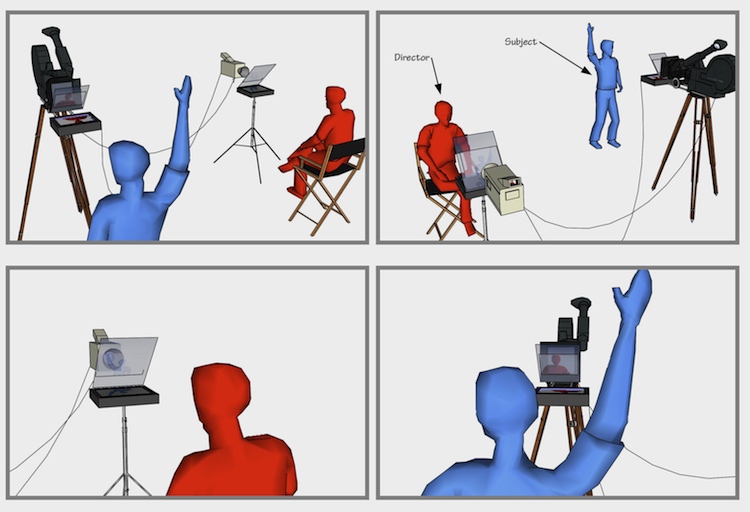
In any Errol Morris movie,
you’ll notice the unique documentary style of his interviewees talking right
into the camera lens. Like many before me, multiple articles have discussed how
Morris shoots the video. By using a two-way mirror with a video monitor mounted
under the camera lens, Morris films his subject and makes eye contact with them
from the same angle. The Interrotron works both ways: the same mechanism that
allows Morris to make eye contact with the interviewer allows the interviewer
to make eye contact with Morris. The outcome is real human intimacy. The
subject becomes comfortable in their conversation with him because they’re not
staring directly at the impersonal camera. They’re having a direct conversation
with a man they have gotten to know and probably like. The audience watching
the documentary also experiences some of this comfort. While watching his
documentary, the interviewers break the fourth barrier by looking directly into
the camera and into the audience.
Side
note: Morris
did not invent the camera angle. Steve Hardie, production designer and
Morris collaborator, invented a nearly identical system before Morris used his.
Thanks to his numerous Oscar winning awards, Morris is now attributed to the
being the inventor of the Interrotron. It’s unique nickname comes from Morris’
wife, Julia Sheehan. The name combined two necessary concepts in his
documentaries – terror and interview.
The most important
attribute of the Morris documentary is how revealing the interviewee becomes
under Morris’ gaze. Let’s take a second to recognize the dramatic moment we all
have when someone makes eye contact with us. Either you look away or you brave
the glare, staring right back. Morris describes the dramatics of eye contact as
“a serial killer telling us that he’s about to kill us; or a loved one
acknowledging a moment of affection. Regardless, it’s a moment with dramatic
value…It’s an essential part of communication. And yet, it is lost in standard
interviews on film.” For him, the Interrotron is Morris’ way of becoming one
with the camera and forcing human interaction. He holds the dramatic eye
contact, creating this beautiful moment between the two of mutual respect,
admiration, and curiosity. Unlike the name, the Interrotron does not seem to
actually terrorize people. In an interview
with FLM Magazine, Morris explains that oddly enough, people feel more
relaxed when they talk to his live video image. His production designer, Ted
Bafaloukos, said, “The beauty of this thing is that it allows people to do what
they do best. Watch television.” The Interrotron creates a comfortable distance
and intimacy that people are familiar with in their living rooms.
The immediately recognizable Morris direct-to-lens feature, the
playful almost circus like music tittering in the background can also be seen
in almost all of his filmmaking. Morris does not only use the machine for his
documentaries, he uses them for his commercials too. One reason behind his
involvement with commercials is definitely monetary. As I discussed earlier,
Morris had early financial difficulties with his second documentary and had to
become a private eye detective to finance his later ventures. As a result, Morris
has filmed over a thousand commercials throughout his career which have helped
to fund his later workds. His first campaign was “Mobile Judge” featuring a
judge who travelled around the U.S. declaring 7-11 to be the best convenient
store. He got his big break
directing commercials after he created a short film that ran at the beginning
of the 2002 Oscar ceremony. Steve
Jobs was in the audience and asked Morris to direct his campaign entitled
“Switch.” Yet why does Morris continue to create commercials? After his
success with Fog Of War, Morris has
been able to receive generous funding and backing for his films.
In an interview
with Cineaste, Morris briefly touched on his love for commercials.
“Cineaste:
You’ve told us that you’ve been very busy in recent years shooting commercials.
Can you name some of the products?
Morris:
I’ve done a whole line of commercials for Miller High Life, I’ve done
commercials for Levis and Volkswagen-for both of which I used the
Interrotron—and I’ve also done commercials for Adidas, Honda, Dell, and Datek.
Cineaste:
You are rarely asked about your commercials, which is obviously a major source
of income for you. Do you like commercials?
Morris:
I love commercials, unreservedly. The haiku of the West. And I like to think of
consumerism as the most effective preventative to genocide yet devised. When
someone shows up at your door and asks you to hack your neighbor to death with
a machete, you’re less likely to do it, if you have prior plans, say, to go and
buy a DVD player.”
In the answer to the
interview question, he realizes the purpose of the commercial: they are meant
to sell you something. Consumerism is the best way to prevent genocide, being
able to purchase a DVD player instead of kill your neighbor is what makes the
United States of America THE United States of America. The ability to transfer
this idea to a commercial and create an intimacy between the viewer and the
product inherently makes the United States a better place. The intimacy that
Morris creates in his documentaries translates well in his commercials. In a
twisted way, the barrier that is broken between the advertisement and the
consumer makes the consumer more comfortable with buying the product or as
Morris said, prevent genocide.
His comparison of
commercials to poetry might be offensive to some but Morris has been so
innovative with his work in the past that a commercial often turns into a much
larger work. For example, one of his latest commercials is for Taco
Bell’s new breakfast menu. Taco Bell gathered real people named Ronald
McDonald and hired Errol Morris to interview them. The commercials feature the
classic Morris whimsical piano background music set up with the interviews
looking directly at the camera. Much like his documentaries, you can hear
Morris in the background asking the poignant questions. In the Taco Bell ads,
he is asking the Ronald McDonalds if they “like the waffle taco.”
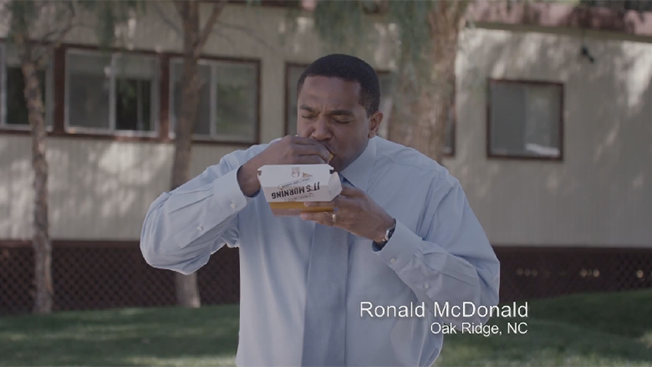
The commercials all start
with whimsical music and shots of men eating the Taco Bell breakfast menu items.
They all introduce themselves and in one commercial, you can hear Morris
yelling “you’re who?!” After a couple more shots of the Ronald McDonalds eating
Taco Bell, Morris asks, “what do you think?” Creatively speaking, the
commercial is not complicated. In the classic Morris style, the commercial is
just a bunch of dudes answering his questions. The advertising agency wanted to
break away from the traditional food commercial featuring beauty shots of fresh
food. For a more intimate commercial, they turned to Morris.
In an interview
with the New Yorker, Morris reveals that he found out a lot more about the
Ronald McDonalds than what appears in the commercials. Some of the material can
be found in the behind the scenes outtakes which are enough to make a mini
documentary ala Morris. One McDonald that didn’t make it into the behind the
scenes cut said, Taco Bell breakfast is insanely
good. And I should know—I work at a maximum-security hospital for the
criminally insane.” Another McDonald confessed that he had been married seven
times. The name apparently is a “real babe magnet”
Through this superficially humorous commercial, Morris finds
a way to seek meaning from his subjects. He used the Interrotron to make direct
eye contact with all of the Ronald McDonalds. Morris told the New Yorker
“people who have worked with me for a long time have said this was my very best
material.” The advertising agency, Deutsch L.A. also had some ingenuity in
hiring Morris to create this idiosyncratic commercial. Deutsch did not tell
Morris Although the commercial is just intended to sell the new breakfast as
well as throw a nice jab at McDonald’s, Morris manages to find a deeper meaning
in Taco Bell A.M. Breakfast Crunch Wrap.
Showing off his
degree in Philosophy, Morris tweets
his fascination over names and their significance in reverence of Saul Kripke’s
theory of connection between names and things in the world: “Rigid
designators v. descriptions. Ronald McDonald (the clown), the Ronald McDonalds
(the persons), & "Ronald McDonald" (the name).” The name is
attached to the cultural association and to the actual person. The line between
the cultural association and implication of the McDonalds name and the person
becomes thin during first interviews. We see them as representatives of the
actual McDonalds and not as real people. The loaded emotions behind the name
were difficult for some. For other McDonalds, there was McDonald pride. In one
of the commercials we’re introduced to Ronald McDonald II and Ronald McDonald
III. Morris asked Ronald McDonald III if he would name his son Ronald McDonald
IV and if he hoped his son would name his son Ronald McDonald V? He answered
yes. However, not all McDonalds feel this way – Morris found in interviews that
some McDonalds changed their name but still saw themselves as “McDonalds,” the
name is “inescapable.” The fine print at the end of the commercial speaks to
the same thin line Morris studied between the clown, the person, and the name. “These Ronald McDonalds are not affiliated with McDonald’s
Corporation and were individually selected as paid endorsers of Taco Bell
breakfast, but man, they sure did love it.”

After watching
the back-story on the Ronald McDonalds, I felt sympathetic towards the men who
have to live with the name Ronald McDonald. The men all thought the commercial
was a scam, a prank phone call that they have all received throughout their
lives, a small glimpse into the life of a “Ronald McDonald” As the Ronalds’
were brought together, they shared stories about growing up and having to
develop a “thick skin” due to all the rampant bullying they encountered. They
shared stories about their first day of school experience and how a teacher
always paused after reading their name off the list. One Ronald showed off his
“stare,” he would give off as a defense measure. Each Ronald shares similar
stories but they’re all from different backgrounds. Ignoring the obvious
product placement of Taco Bell breakfast, the back-story becomes an interesting
look inside the life of men who have to deal with the consequence of being
associated with a big scary red fast food clown. Who would have ever thought
twice about the implications of being named Ronald McDonald and whether there
would be pride or shame entangled with the name? Morris asks the questions we
might briefly consider but never act upon regardless of the artistic medium.
Whether it’s a documentary, a tweet, or a commercial, Errol Morris makes us
question the reality of our perception and gives us insight into a world that
we may have otherwise ignored.
Television
commercials and smaller projects of his seem to often give him guidance as to
what his next project could be. Just as he uses his twitter as a drawing board
for his blog, the Morris commercial becomes an inspiration board for a greater
documentary. Much like his work with the behind the scenes of Taco Bell, Morris
used outtakes of a Donald Trump interview for a commercial to create a mini
documentary about the man. If he can get permission from Taco Bell, he wants to
make a similar mini documentary about the Ronald McDonalds of the world. This
is what I love most about Morris, his ability to create a story about the most
unusual things. While he was not the mastermind behind the Taco Bell Ronald
McDonald commercial, he took something as contrived as a breakfast
advertisement to create something thoughtful and enlightening.
Subscribe to:
Posts (Atom)